 TruMile
Mileage tracking for Insurance Claims Adjusters
Many claims adjusters drive 15,000 to 45,000 business miles a year. At the 2026 IRS standard rate of 76 cents per mile (72.5 cents for trips before July 1), that is a deduction range of $11,137 to $33,413 for the workers who can claim it, assuming those miles fall evenly on either side of the July 1 rate change.


Typical 2026 deduction
$11,137 to $33,413
15,000 to 45,000 business miles a year
Who can deduct
Staff adjusters employed directly by a carrier are W-2 and cannot deduct mileage on the federal return (TCJA 2018, made permanent by the One Big Beautiful Bill) - some carriers provide a company car or a mileage-reimbursement program instead. Independent adjusters (IAs) who contract through an independent adjusting firm, and catastrophe (CAT) adjusters who deploy after storms, are almost always 1099 and deduct business mileage at the 2026 IRS rate of 76 cents per mile (72.5 cents for trips before July 1). Check your engagement letter or 1099 vs. W-2 status before assuming either way.
How they drive
How claims adjusters actually drive
A staff adjuster covering a fixed territory of routine claims commonly logs 12,000 to 20,000 miles a year. An independent or CAT adjuster deployed after a hurricane or hailstorm, inspecting 4 to 8 properties a day for weeks at a time, can log 30,000 to 45,000 miles in a single deployment season.
Typical deductible trips
The trips below are the ones claims adjusters most commonly forget to log, plus the obvious ones. Auto-tracking catches all of them, including the small ones that add up.
- Driving to inspect storm, fire, or water-damage property claims
- Driving between multiple claim sites in the same day, often for different carriers if working through an independent adjusting firm
- Driving to a body shop or salvage yard to assess a vehicle damage claim
- Driving to a policyholder's home to re-inspect after a supplement or dispute
- Driving to a CAT deployment staging area or temporary claims office after a declared disaster
- Driving to depositions, mediations, or attorney meetings on a contested claim
How TruMile helps
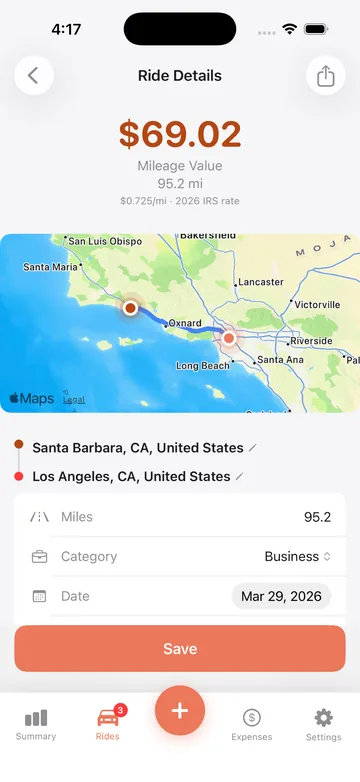
TruMile auto-detects every drive using motion plus location, so the trips above get logged whether you remember them or not. Smart classification learns your repeat routes and starts tagging them automatically after a few trips.
At year-end, one tap turns your trip log into an IRS-compliant CSV or PDF you can hand to your accountant or paste into Schedule C. The math is already done.
Free for 40 auto rides a month, every month. If you are anywhere near the high end of the typical mileage range, the unlimited Pro tier at $7.99 a month or $59.99 a year usually pays for itself in the first week of tax season.
FAQ for claims adjusters
I'm a staff adjuster with a company car. Is my driving still relevant for taxes?
If the carrier provides the vehicle and covers its costs, there's usually nothing left to deduct on that vehicle. If you use your own car and get reimbursed, only the un-reimbursed portion (if any) could matter, and W-2 employees still cannot claim a federal mileage deduction on top of that. Track your miles anyway: it is the evidence your reimbursement claims and expense reports need.
I'm an independent adjuster (IA) working through a firm that assigns me claims from several carriers. What counts?
If you're 1099, every claim-related mile is business mileage regardless of which carrier the claim belongs to, including driving between two unrelated carriers' claims on the same day. The IRS cares about business purpose, not which client you're serving.
I deployed out of state for 6 weeks after a hurricane. Is that different from normal mileage tracking?
CAT deployments add travel-away-from-home expenses (lodging, per diem, mileage to and from the disaster area) on top of ordinary local claim-to-claim driving. Keep the deployment's driving log separate from your home-market log; a CPA experienced with CAT adjuster taxation can also help you claim the travel expenses correctly.
Related guides and resources
Start tracking your claims adjusters miles for free.
40 auto rides a month, free every month. Switch from any tracker with a one-tap CSV import.

TruMile
Automatic Mileage Tracker and Expense Log
5.0 on the App Store
For iPhone